Concertina- Reel Conversation
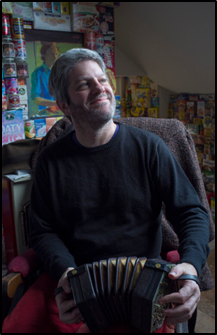
“Music is a language of its own really. It’s a way of communicating.”
~Jason O’Rourke, Concertina Artist
Last spring, I met the internationally renowned concertinist, Jason O’Rourke. O’Rourke is originally from London, but as a way to connect with Irish roots, eventually pursued traditional music and life on the Irish Island. He is a Belfast musician, performing in weekly sessions around the city, while composing his own music. He performs annually in the “Fleadh Cheoil na hÉireann” (an Irish music festival). O’Rourke also travels the world to collaborate on music projects and promote the arts.
In an interview, O’Rourke explained his love of music and why he believes it connects us all.
“When you’re in a session, and everything clicks all of a sudden, and everyone is playing together,” he said. “There’s that feeling, and I don’t think there’s any feeling like that in the world really.”
As a musician myself, playing alongside O’Rourke in pub sessions, I have to agree. That idea of the notes bringing us all together, especially in a spontaneous pub session, is truly remarkable. Strangers become family, and when we are all in unison, no other feeling can compare.
“The point of the sessions is to play music with other people,” O’Rourke said.
O’Rourke described how his musical journey began. At twenty years old, he decided to move out of his childhood home and travel to Oxford, England. As he navigated the music scene, he was immediately struck by what he found.
“As the bar was closing, I saw all of these people with instruments coming in,” he said. “These people looked like they were having more fun than me.”
As O’Rourke he was tearing down equipment from a gig one evening, he noticed a group of lively, traditional Irish musicians gathering. Everyone flashed smiles across their faces as one by one they came together to host a session, all united with tunes and laughter. O’Rourke witnessed first-hand just how musical rhythms can form a powerful community.
“Sometimes places are very, very influential for people, because they become sort of a nexus for musical communities.” O’Rourke said. “The atmosphere is good for music.”
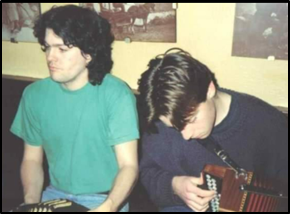
Featured, left to right, O’Rourke with friend Luke Daniels playing Oxford
(photo from Facebook)
O’Rourke’s musical career did not always consist of Irish tunes. In fact, they almost drove him away from the music industry.
O’Rourke shared about his father, holding Irish roots, hoped his sons would embrace the Irish music. However, as O’Rourke picked up the whistle, it did not go as planned.
“Unfortunately, the tin whistle is not for me,” O’Rourke laughed. “I was like, alright I can’t do this. And that was nearly the end of my musical career.”
However, just like any good parent, a mother stepped in to save the day.
“I told my mother I can’t do this and she was like, in a moment of brilliant parenting ‘well maybe you’re not musical?’ and I was like gasp! I’ll show her.” O’Rourke said.
And the rest is history- in attempts to defy his mother’s untalented suggestion, O’Rourke became the concertina player we all know and value.
Musician and artist huh? So, you must be starving on the streets…
Contrary to the cultural stereotype, O’Rourke is another example of how music can and should be a way of life.
“Imagine life without it [music]. What does that look like?” he said. “Can you avoid music? Can you avoid rhythm? You can’t, because you have a heartbeat. So if you’re not experiencing rhythm, you’re dead … Music and rhythm cannot be avoided, so embrace it.”
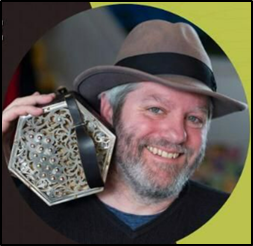
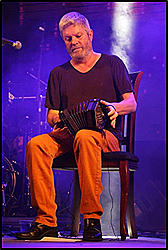
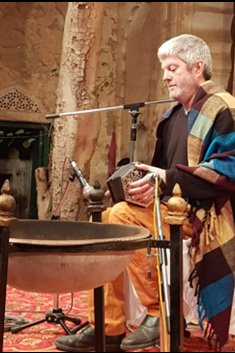
Images of O’Rourke performing with his concertina (from Facebook)
Not only is O’Rourke skilled at the concertina, but he ranks high in the world of academia. He is a published medievalist, academic editor, and his research projects have even enabled some of his musical voyages.
“When I first arrived in Tokyo, for example. I was there to look at some medieval manuscripts in a private collection,” O’Rourke said. “But I brought the concertina with me because you never leave home without it.”
O’Rourke was able to perform with his concertina and described the significant impact Japan’s culture had on him.
“I saw the airport workers doing their morning exercises, tai chi. I just thought that was brilliant, because it was a completely different culture, which is very liberating,” he said. “People just treat you like you’re a stupid foreigner, not in a bad way… ‘oh he’s making a mess of his dinner, let’s help him out.’ So people are very friendly, very tolerant.”
O’Rourke has encountered similar interactions with culture everywhere he has traveled. As he follows his love of music, he has visited sites in South Africa, South America, the United States, various countries across Europe, and even Asian countries, including Japan, Thailand, and Cambodia.
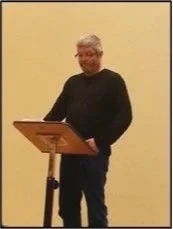
O’Rourke presenting his prose piece,
“You are my Sunshine”
(photo from O’Rourke’s personal website)
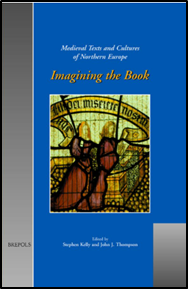
Other Publications: O’Rourke has a PhD in Medieval History!!!
His website references his academic writings. Here is an example of a featured chapter.
Cover of text containing O’Rourke’s published chapter, “Imagining Book-Production in Fourteenth-Century Herefordshire: The Scribe of British Library MS Harley 2253 and his ‘Organising Principles.’”
(photo credits: Brepols Publishers)
Belfast and Beyond
While in Cambodia, O’Rourke had the opportunity to assist with a documentary production. He met activist and Cambodia Living Arts Founder, Arn Chorn-Pond. (more on Cambodia and Arn Chorn-Pond’s role with Khmer Rouge later in article) For O’Rourke, his time in Cambodia was lifechanging.
“[Arn Chorn-Pond ]was like a father to all of these young musicians I was playing with,” O’Rourke said. “He gave me the biggest hug ever. He really appreciated the whole project and he said, ‘thanks for bringing our music to the world,’ and it was the most amazing feeling, this hug”
Cambodia was not the only place O’Rourke felt such a strong, comforting presence in a musical interaction.
“The only time I’ve had anything similar was with a guru in West Bengal a couple of years ago who gave me a hug, and it was just amazing, you know feeling all this spiritual kind of energy being transmitted in one way or another,” he said.
O’Rourke mentioned how he is highly supported by Northern Ireland’s Council of the Arts. Grants and other funding opportunities have allowed him to travel to multiple countries and not only share the Irish culture with others, but learn lessons from others to take home. By doing so, and with more support, the influence and appreciation of music will only grow.
“Music can be inspirational. You know that moment when you hear something so good it sends a shiver down your spine- you get an adrenaline rush. What’s that all about? That’s about the music moving your entire spirit.”
~Jason O’Rourke
View both O’Rourke’s music and academic publications here: https://jasonorourke.info/works/publications/
The Cambodia Project
In early 2020, O’Rourke traveled to Cambodia to partner with Cambodia Living Arts and lead a musical exchange. During our interview, O’Rourke reflected on not only the success of the arts program, but also the compelling story of Founder Arn Chorn-Pond.
Chorn-Pond grew up during the 1970’s Khmer Rouge reign. He was a child soldier, and in his TEDTalk, argues how music saved his life. He learned a propaganda song, and while he did not like it, desperately played it each day to receive extra rice. Throughout his childhood, he was forced to perform cruel acts to survive, watched countless civilians die, and even witnessed his own sister starve to death.
In his teenage years, Chorn-Pond escaped the jungle and fled to Vietnam. While there, an American adopted him and helped him move to the United States. Later in life, Chorn-Pond returned to Cambodia, discovering all of his family dead. However, he was surprised to see someone he knew in the streets.
He found his old music teacher in the streets, cutting hair and drinking. “If you don’t find something for me to do, I’m going to die here,” Chorn-Pond said in the TEDTalk.
Realizing the severity of his teacher’s condition, Chorn-Pond decided to begin a music school with his teacher. The program Cambodia Living Arts began as a way to preserve Cambodian culture.
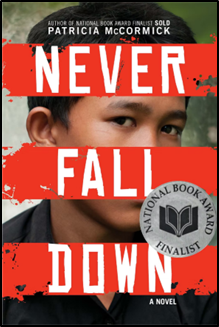
Cover of Patricia McCormick’s text Never Fall Down
(Photo Credits: McCormick’s Website)
During our interview, O’Rourke explained to me how nearly 90% of musical instruments were destroyed under the Khmer Rouge Regime. However, with the efforts of Chorn-Pond and many others, instruments were recreated. They studied temple statues and artwork that depicted the historical instruments and began to recreate.
For the Cambodian Exchange project, displayed in the documentary, O’Rourke met with Cambodian musicians and intertwined Irish tunes with Khmer melodies.
“One of the things you always take back is new little bits of melodies that kind of stick in your head,” O’Rourke said in the documentary. “I think probably I’ll be incorporating some of the tings I learned here into my own new compositions … These things have a natural way of coming out when you experience them.”
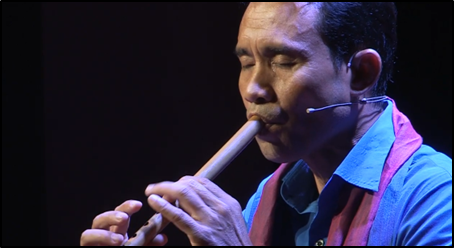
The documentary opens with an image of musicians seated together on the ground, barefoot. While words may not be a common language, the sound of music is something everyone could relate.
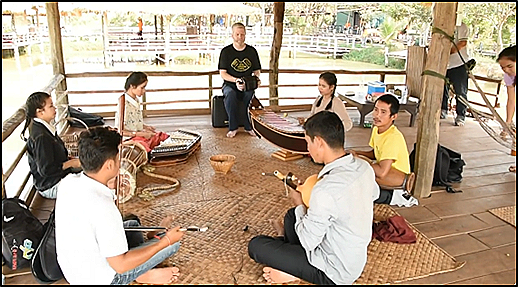
Documentary’s Opening Scene (on YouTube)
“So it’s a challenge for everyone,” O’Rourke said in the documentary, referencing him learning Khmer rhythms, and the students Irish rhythms.
The purpose of the project was to share Cambodia’s music with the world, and O’Rourke believes it is doing just that.
“Hopefully this will be the start of something bigger, and hopefully it will involve bringing the musicians to Ireland. That would be something I would love to do,” O’Rourke stated in the documentary. “For them to experience what it’s like in our culture, and to go out and see some live music in Ireland and experience that.”
How to Support O’Rourke and Other Musicians
Bandcamp!
O’Rourke clarified that Spotify is harmful for local musicians, as the company is the one who sees the profits. By downloading music directly from Bandcamp, artists receive the earnings they deserve from their hard work.
O’Rourke’s Music:
*https://jasonorourke.bandcamp.com/album/the-sunny-side-of-the-latch
Website:
*https://jasonorourke.info/
“Music can be inspirational. You know that moment when you hear something so good it sends a shiver down your spine- you get an adrenaline rush. What’s that all about? That’s about the music moving your entire spirit.”
~Jason O’Rourke
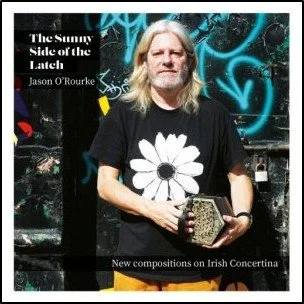
Photo of O’Rourke’s most recent album, The Sunny Side of the Latch
(photo credits: O’Rourke’s website)